
Taxation, succession, governance: why real estate funds are gradually emerging as a structural answer to today’s wealth-management challenges.
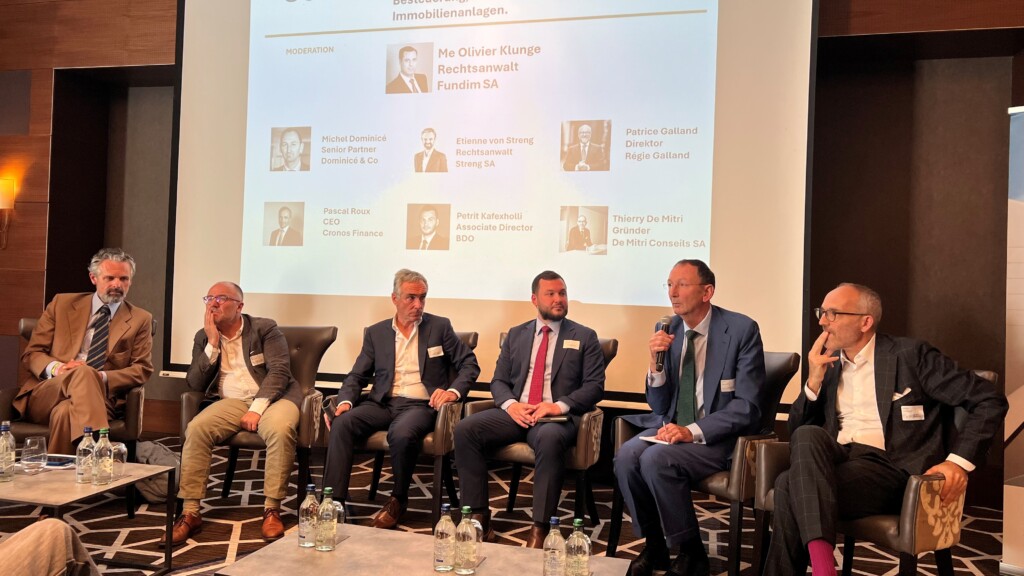
COPTIS, the Swiss Association for Real Estate Securitisation, brought together lawyers, tax experts and fund managers for a panel entitled “Challenges of real estate ownership: optimising management, financing and taxation, notably through indirect real estate,” to discuss the transformations reshaping property ownership in Switzerland today.
Moderated by Olivier Klunge, FSA-certified attorney specialising in construction and real estate law at BOURGEOIS AVOCATS SA, the discussion brought together Étienne von Streng, attorney and tax expert at Streng SA; Michel Dominicé, Senior Partner at Dominicé & Co – Asset Management; Pascal Roux, CEO of Cronos Finance; Patrice Galland, Director of Régie Galland; Thierry De Mitri, certified tax expert and founder of De Mitri Conseils SA; and Petrit Kafexholli, Associate Director at BDO.
Together, they addressed the issues surrounding real estate taxation, succession, family governance and the growth of “swap” transactions (contributions in kind) between directly held properties and real estate fund units.
A Promising Mechanism
The swap is attracting growing interest in Swiss wealth-management circles. Michel Dominicé, however, opened with a blunt observation:
“The swap is something people talk about far more than they actually do.”
Actual transactions remain rare, often partial — combining fund units, debt assumption and cash payments — and require precise alignment between the seller’s expectations and the acquiring fund’s strategy.
Yet this gap between talk and reality does not stem from any lack of relevance in the mechanism itself. It stems from the emotional and technical complexity of a major wealth decision — because when the conditions are right, the arguments in favour of the swap are strong and multidimensional.
The Tax Advantage: A Structural Asymmetry in Favour of the Fund
The first argument is fiscal, and it is a powerful one.
As explained by Étienne von Streng, under direct private ownership, the owner bears income tax on rental income of up to 45% in Geneva, as well as wealth tax and property tax — varying by canton — on the value of the building. In addition, they are exposed to the risk of being reclassified as a professional real estate dealer in the case of a significant portfolio, particularly where transactions or sales are repeated. The recent vote on the imputed rental value further increases this burden, as it will soon eliminate the deductibility of maintenance costs (for owner-occupied properties) and mortgage interest — two historic pillars of private ownership.
“Many people have not yet grasped the tax impact of these changes,” he pointed out.
The real estate SICAV operates under a radically different regime. Taxed at a direct federal tax rate of 4.25% instead of 8.5%, it benefits from full deductibility of its expenses, exempts the investor from real estate capital gains tax on the resale of SICAV units, and limits wealth tax to the non-real-estate portion of the holding.
For Thierry De Mitri: “Through securitisation, you effectively relocate your property for tax purposes, particularly with regard to inheritance and gift taxes.”
Pascal Roux added: “This type of vehicle, if well managed, is fiscally preferable to any other form of real estate ownership.”
The transfer nonetheless comes at a cost: transaction fees and real estate capital gains tax at the time of the contribution. But this initial cost is absorbed by the recurring tax differential. Once the units are held, future real estate gains are no longer taxed. Over the long term, the advantage prevails.
And as Michel Dominicé pointed out, the swap can be structured partially — combining units, cash and debt assumption — to smooth the immediate impact of the transaction.
The Succession Advantage: Units Rather Than Bricks
The second argument concerns succession.
Pascal Roux, drawing on his experience in wealth transfer, described the reality on the ground: passing on a building in joint ownership generates deadlocks, conflicts between heirs and significant legal costs.
“Securitisation will make gifting simpler and fairer. Everyone can then do as they wish with their units.”
Michel Dominicé added: “These are real anxieties we hear about. Direct ownership brings a sense of psychological security or prestige.”
For some, this turns out to be more of a philosophical choice: either you hold a building yourself, with everything that entails, or you choose a real estate fund according to your convictions and objectives.
But this loss of operational control, Michel Dominicé noted, comes with a considerable gain in wealth-planning flexibility. Units can be gifted, divided and transferred with a fluidity a building will never allow. And the family governance problems tied to joint ownership — emotions, deadlocks, disagreements between heirs — disappear with securitisation.
The Operational Advantage: Delegating a Growing Burden
The third argument relates to how the role of property owner is changing.
Michel Dominicé traced a clear trajectory: “Yields used to be 6 to 8%. Today, they are much lower. After tax, the difference becomes enormous.”
At the same time, regulatory requirements — energy legislation in particular — are considerably increasing the management burden.
“Being an amateur property owner is becoming too heavy a job.”
Faced with this dual trend — falling yields and rising constraints — the professional fund offers a structural response.
Michel Dominicé stated it plainly: “We are far better equipped to handle the energy transition than a private individual.”
For Pascal Roux: “With a fund, you get more return, less risk and fewer worries.”
The question of the premium (agio) on listed funds — a market premium averaging 30% on Swiss funds — nonetheless sparked a technical debate. Entering a fund at its market price when the premium is high means paying a premium over net asset value, which raises questions about the economic soundness of the transaction.
Michel Dominicé offered a nuanced reading: “The premium also reflects a liquidity premium and a fund’s maturity.”
Systematically rejecting any swap on the grounds of the premium would, in his view, be logically incompatible with the very idea of a capital increase:
“That would amount to saying the premium is a heresy.”
Petrit Kafexholli recalled the fundamental requirement from an auditor’s perspective: “Our role is to ensure that the transaction is carried out under the best conditions and in full transparency. The investor must have all the information needed to properly assess the risks.”
A Sign of Market Maturity
Michel Dominicé concluded the discussion with an observation that goes beyond the swap itself: the quality of a real estate fund also depends on the profile of its investors. “We target private investors more, as they are less sensitive to interest rates. The nature of the investors influences a fund’s market behaviour.”
The swap is therefore not merely an individual wealth-planning transaction — it helps shape the structure and resilience of the funds that practise it.
Michel Dominicé put it precisely: “The swap is the combination of two operations: selling buildings and investing in investment funds.”
A definition that serves as a reminder that behind the tool lies, above all, a long-term, reasoned and structured strategy.
In Summary
The panel highlighted that, under the right conditions, the tax, succession and operational advantages of collective investment funds now make them a structurally superior alternative to direct private ownership for a growing number of property owners.
The real question is no longer whether the swap is relevant, but for whom, at what point in time, and into which fund.