
Published in Bilan in collaboration with Dominicé, this article highlights our approach to real estate value creation through two projects in Lausanne: Bergières 59 and La Borde 17. Two different strategies – renovation and vertical extension in one case, demolition and reconstruction in the other – with the same objective: unlocking the long-term potential of real estate assets.
What if the next real estate gems were hiding where no one is looking? Along the Lake Geneva region, well-located development sites are becoming increasingly scarce. Yet opportunities have not disappeared. They may lie within existing buildings whose potential has yet to be unlocked. The challenge is knowing how to identify that potential before any transformation even begins.
At Dominicé, this search for potential starts at the acquisition stage. Beyond location and immediate yield, the analysis focuses on what a property could become over the medium and long term. It is an approach that remains relatively uncommon in the sector. The Bergières 59 and La Borde 17 projects are two examples.
“A well-located property has intrinsic value, but this can be further enhanced through renovation, vertical extension, restructuring or, when the building no longer meets current requirements, reconstruction,” explains François Lemercier, Real Estate Project Manager at Dominicé. “It all starts with asset selection. We focus on properties that, even if ageing or underutilised, still offer significant potential for improvement.”
Nearly 30% of the Geneva-based company’s portfolio has development potential that could be realised over the next five to ten years. The objective is to enhance existing assets and create sustainable long-term value.
Unlocking the potential of Bergières 59
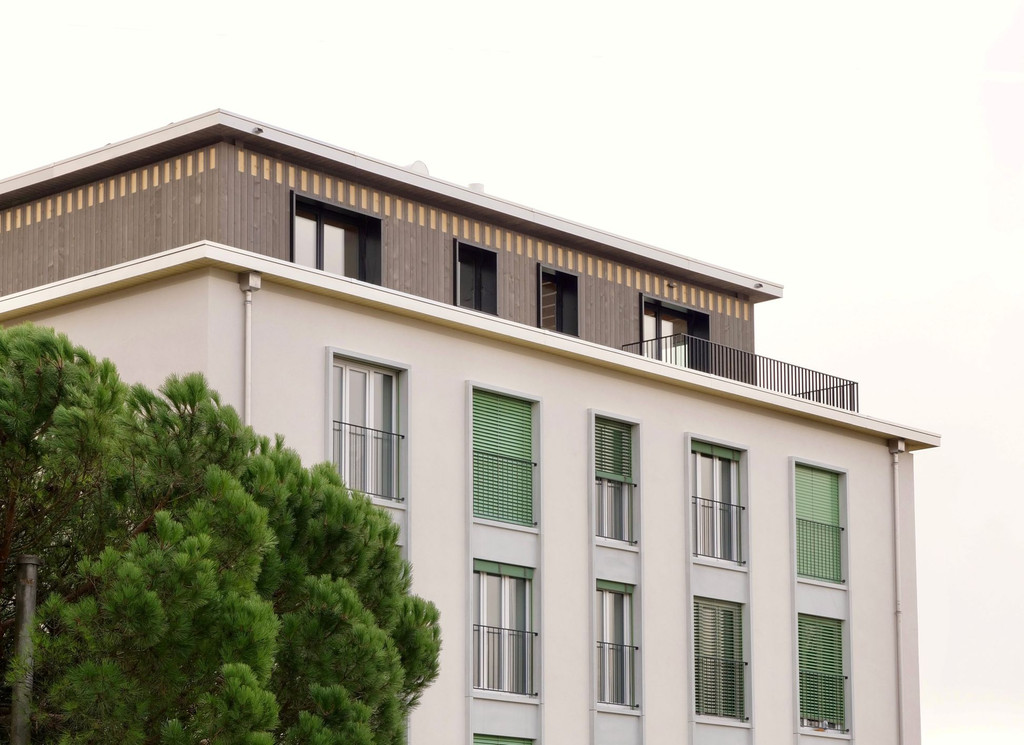
At Avenue des Bergières 59 in Lausanne, the challenge was to unlock the potential of an existing property through transformation. Dominicé combined a comprehensive energy renovation of the building with the addition of a new top floor.
The project included the construction of a 77 m² penthouse with a 38 m² terrace overlooking Lake Geneva. But the challenge went beyond creating additional living space. It also involved significantly improving the building’s energy performance.
The oil-fired boiler was replaced with an air-to-water heat pump, while the building envelope was upgraded. “The building now consumes significantly less energy than before, with a substantially reduced carbon footprint,” says François Lemercier.
The transformation also delivered tangible economic results. Annual rental income increased by 30%, representing more than CHF 100,000 in additional income per year.
“With this project, we sought to bring together several dimensions that are often considered separately: energy performance, occupant comfort, preservation of the existing building and value creation,” adds the trained engineer.
La Borde: rebuilding to increase density
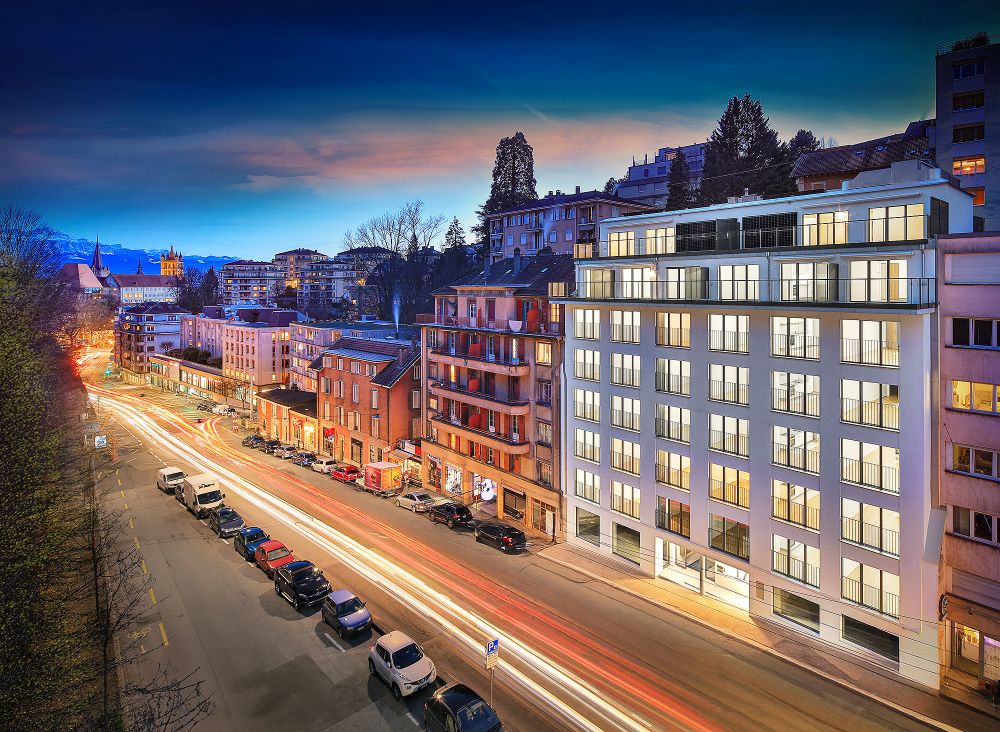
The La Borde 17 project followed a different approach while pursuing the same objective. Faced with an ageing building constructed in 1945, where a significant portion of the site’s development rights remained unused, Dominicé chose to demolish and rebuild.
The result: the property’s lettable area increased from 927 m² to 1,456 m², with 29 apartments and two commercial units replacing the previous seven apartments and two offices. The new building was completed in January 2025.
“In this case, renovation would not have allowed us to fully realise the site’s potential. The existing building was therefore demolished to make way for a new development,” explains François Lemercier.
Energy performance was also a key consideration. The building now meets the Minergie standard and features rooftop solar panels as well as a thermal envelope compliant with current standards.
The environmental implications of demolition and reconstruction nevertheless deserve careful consideration. Rebuilding inevitably requires the use of additional resources. In the case of La Borde, Dominicé concluded that the condition of the original property would have required substantial investment in renovation without achieving the same performance as a new building.
Two strategies, one objective
Bergières 59 and La Borde 17 illustrate two ways of unlocking the potential of existing real estate: renovation and vertical extension in one case, demolition and reconstruction in the other. Both are based on the same principle: identifying what more a location can offer and selecting the most appropriate strategy to realise that potential.
“We do not view a property and its resources as a static asset. Its location, condition, development potential and energy performance are all factors that need to be considered together,” explains François Lemercier.
Value creation therefore depends not only on what a property can become, but also on its acquisition price. La Borde provides a concrete example: acquired for CHF 4.3 million in 2016, the project subsequently required CHF 8.3 million in reconstruction works. The property now generates CHF 573,000 in annual rental income, corresponding to a gross yield of 4.4%. All 29 apartments have also been fully let.
Transforming a building or completely rethinking a site requires striking the right balance between building quality, environmental requirements and economic realities. It is this dual capability – identifying an asset’s qualities and potential from the acquisition stage and then knowing how to enhance it over time – that guides Dominicé’s approach.
Because the value of a property lies not only in what it is today, but also in what it can become tomorrow.